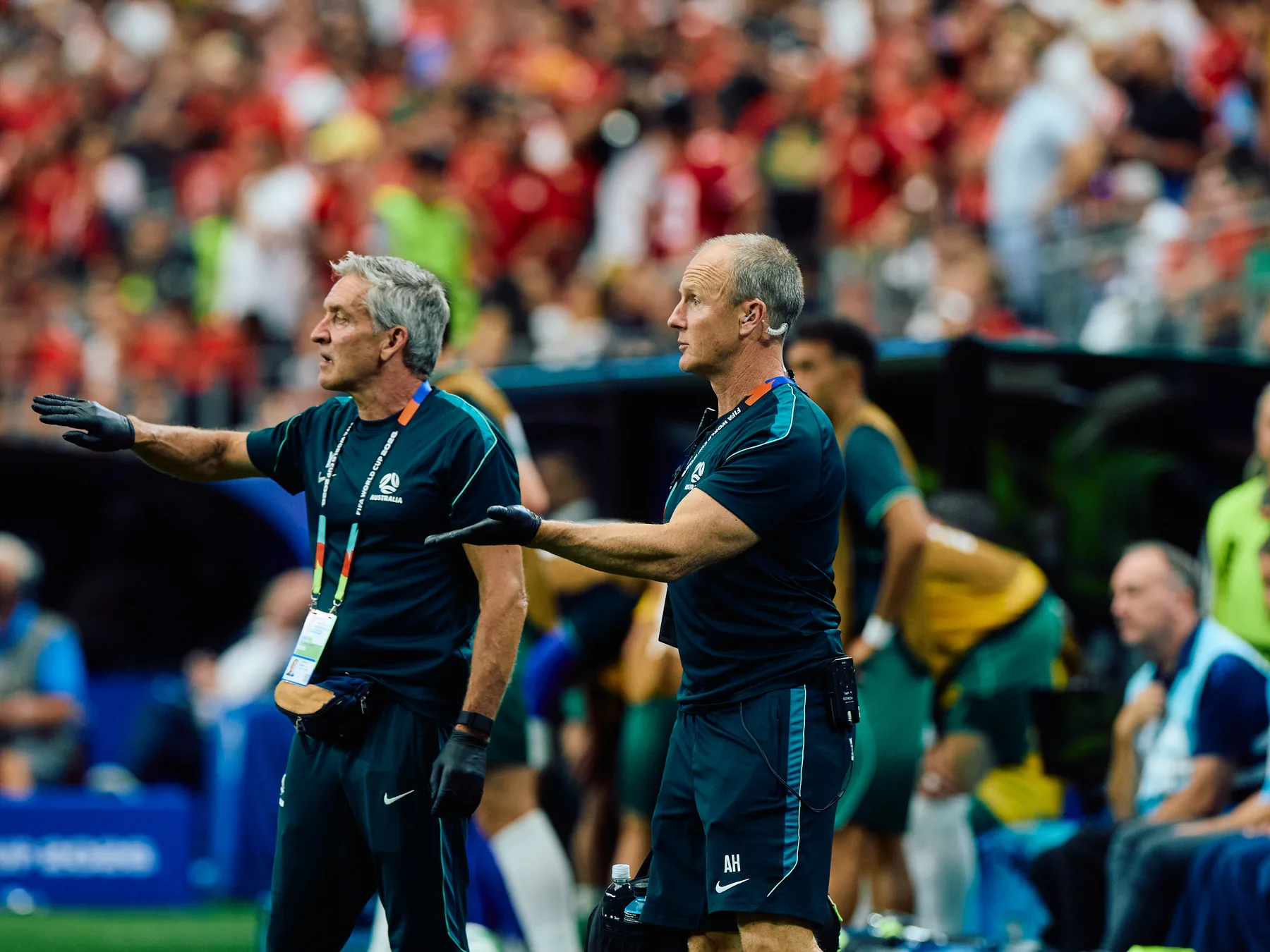
The Socceroos recently competed at the 2026 FIFA World Cup, hosted by the USA, Canada and Mexico. Dr Jones accompanied the team in his role as team doctor for his fourth consecutive Football World Cup.
A significant amount of preparation by the Australian team occurred prior to the World Cup in every aspect of the team’s functioning. A major decision required was to finalise the base camp where we would reside and train during the World Cup tournament. Criteria for our base camp focussed on training, rehabilitation and recreational facilities available, transport requirements to training and matches, climate, security etc and there was close collaboration between the coaching, Medical and Sports Science, and Management departments of the team in agreeing to the location.
FIFA provided a medical workshop in Atlanta, Georgia, in March 2026 for all team doctors, where relevant medical matters and medical logistics were discussed to assist doctors in their role at the World Cup.
All team doctors were required to complete FIFA education modules on concussion and emergency treatment on the field of play. These supplemented practical training workshops provided at the Atlanta workshop.
Medications, supplements, and information detailing quantities, manufacturers, indications, etc., were required by the customs departments of the host nations, together with other relevant paperwork prior to departing for the World Cup.
The Socceroos Medical and Sports Science team monitored the health status and training and playing loads of prospective players prior to commencing a training camp in Sarasota, Florida, in early May. The goal of the training camp was to provide physical conditioning in the lead up to the first competition match, and also for purposes of heat acclimatisation for the physiological benefits arising from this. Training was held at the famed IMG complex, renowned for its high school graduates who have become international professional sporting stars.
An extended playing squad was selected for the Sarasota training camp. All players were screened fully on arrival with respect to medical and physical examination, cardiac screening, SCAT6 concussion testing, and nutritional, psychological and musculoskeletal screening by other staff members, including the psychologist, dietitian and physiotherapists.
The training camp routine for Dr Jones consisted of attendance at all team training and strength sessions, daily medical and sports science meetings to discuss each player’s progress and health status, and treatment of ailments and/or injuries in addition to the arrival screenings. Dr Jones arranged and accompanied any player requiring updated cardiological screening or radiological testing.
The Socceroos played a practice match against Mexico at the iconic Rose Bowl in Los Angeles in front of a full house of partisan Mexican supporters.
The final official Socceroos squad for the World Cup was announced following the match. Dr Jones and the Socceroos psychologist provided support for those players who were released from the team prior to their return home.
A second practice match was played against Switzerland in San Diego and provided an opportunity to replicate the travel logistics from our base camp in Berkeley, San Francisco, which would be required for our group-stage matches.
The group-stage matches were against Turkey in Vancouver, the USA in Seattle, and Paraguay in Santa Clara.
Travel to these venues for the first two matches included charter flights from Oakland, our choice of training facility near to our residence. The Socceroos contingent flew to the match venues the day before, with the team returning to our base camp by flying out directly after each match. The Santa Clara match was relatively close to our base camp and required a bus trip only, this being an additional reason to base ourselves at Berkeley for the tournament. Hence, there was a strong emphasis required on recovery to enable optimum preparation for the subsequent match.
Recovery facilities at our base camp at the Claremont Hotel in Berkeley include a large gymnasium, sauna, ice baths, swimming pool and a recovery room furnished with various modalities by one of our sponsors. Our 3 chefs appointed as staff to the Socceroos provided first class food for performance to meet our nutritional needs. Sleep hygiene and optimisation was a priority and we were supported by a Sleep company who provided their expertise and products such as custom pillows for staff and players, and cooling sheets. Soft tissue massage, yoga and flexibility sessions were regularly scheduled throughout the training program.
Maximisation of general health and well-being was also a priority. Air purifiers to minimise infection risk were strategically placed in key rooms at The Claremont Hotel where there was a large amount of traffic of players and/or staff, such as meal room, social room, treatment and Sports Science rooms, meeting room etc. Usual hygiene practices were enforced. Players also had access to red light therapy for the diverse benefits that it can provide such as recovery, rehabilitation, general wellness, assisting sleep etc.
A significant amount of time from the medical, sports science, nutritional and psychological staff was spent on players for clinical recovery as an adjunct to the facilities and modalities players were provided to maximise their performance and health.
Daily medical and sports science monitoring on Football Australia’s Athlete Monitoring System continued throughout the whole of the tournament and aided decisions on fitness, wellness, match and training availability etc.
The stadium facilities for matches were first class. The crowd atmosphere was loud and supportive. Australian fan support was very strong, with highlights including our dynamic win against Turkey in the opening match and celebrating qualification for the knockout phase following the draw with Paraguay.
The team left its base camp after the final group-stage match and arrived in Dallas, Texas, a couple of days prior to the Round of 32 match against Egypt. The Socceroos were beaten in a penalty shootout after extra-time and were thereby eliminated from the tournament.
Dr Jones’s tasks during the World Cup involved the prevention and treatment of injury and ill health for players and staff, pitch-side treatment during matches, arranging and accompanying players for radiological investigations in relation to injuries, assisting with nutritional supplementation to maintain optimum health, involvement in regular sports medicine and sports science meetings, liaising closely with coaching staff, and accompanying players selected by Doping Control for drug testing during the pre-camp and the mandatory post-match testing.
As always, the World Cup was an amazing experience—the ultimate sporting experience, bringing together fans from all over the world in a spirit of respectful rivalry.
In September 2026, the Socceroos reassembled for friendly matches in Queensland against world-ranked number 6 team, Brazil, in a very competitive display as we prepare for the upcoming Asian Cup Finals to be held in Saudi Arabia in January 2027 and attempt to build upon and draw on our recent World Cup experience.